



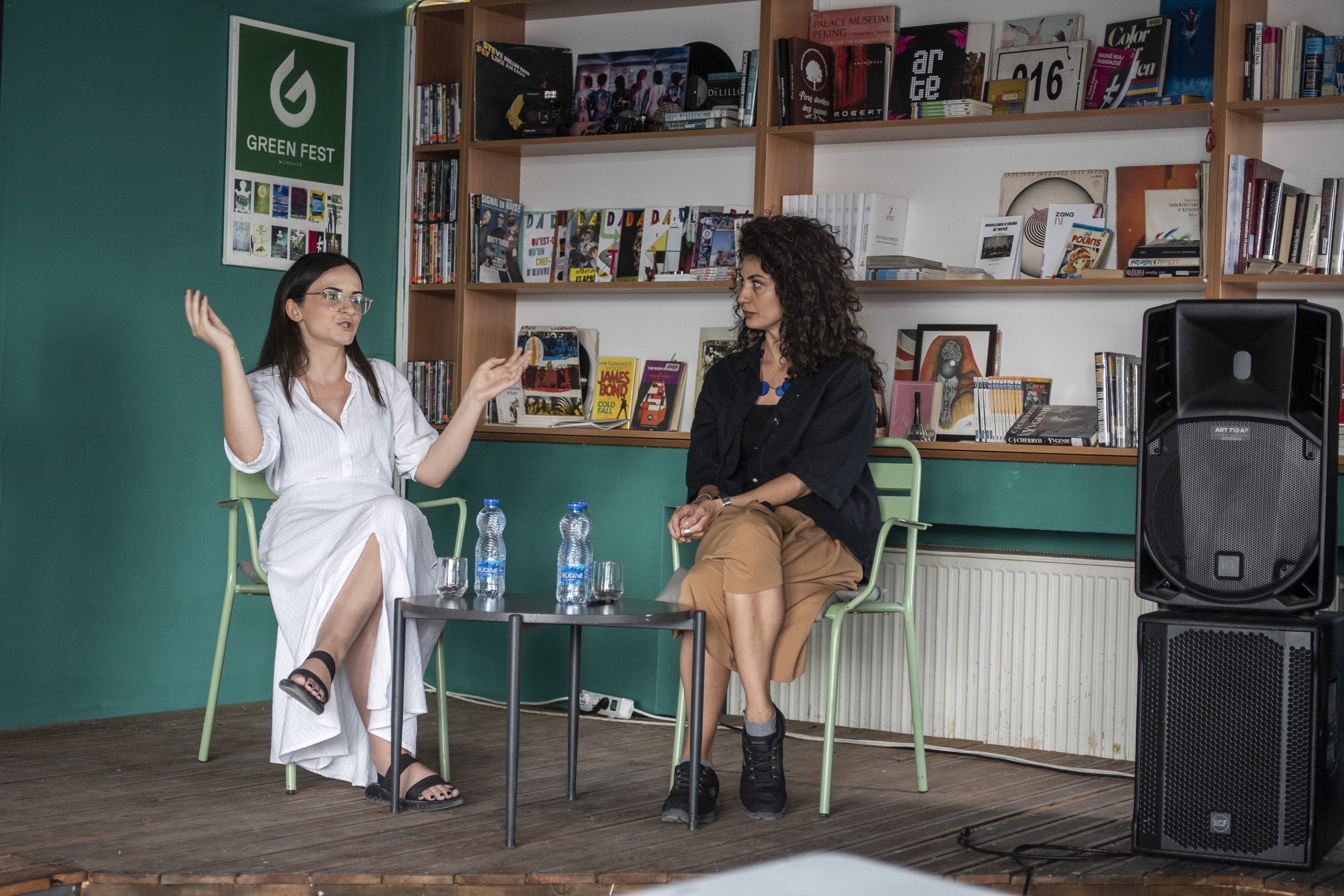
Green Talks: “Psychological Well-being in Industrial Cities”
In a city that has carried the burden of the largest metallurgical industry in the Balkans for decades, one of the deepest discussions of Green Fest 15 took place. Under the Green Talks program, anthropologist Rozafa Berisha and psychologist Veronë Perçuku led an open conversation titled “Psychological Well-being in Industrial Cities”, part of this year’s Green Talks.
The discussion highlighted that toxicity is not only chemical and measurable with instruments but also social, cultural, and psychological. It manifests in how relationships are built, the level of social polarization, the isolation of communities, and the feeling of losing control over life.
“Toxicity is not just pollution in air or water. It shows up in how we speak to each other, how we exclude one another, how we ignore problems. It is part of our daily life,” said anthropologist Rozafa Berisha.
Psychologist Veronë Perçuku brought the discussion to the dimension of mental health: “The brain makes survival compromises. When faced with pollution and chronic stress, it chooses faster pathways to conserve energy, sacrificing the capacity for focus, creativity, and deep processing. This leads to feelings of powerlessness and increased depression.”
The audience raised the question of whether pollution affects intelligence. Perçuku cited international studies with genetically identical twins, showing that growing up in environments with different levels of pollution is linked to lower cognitive abilities and higher signs of oxidative stress in the brain. “This does not mean entire communities are ‘less intelligent’—but that quality of life drops and inequalities deepen,” she explained.
One of the most discussed topics was hope. Berisha emphasized that hope is not a spontaneous feeling but a social construct: “Hope is built through safe spaces, community, and tangible results that people can see.”
The debate also touched on industrial compromises. What do we choose: a factory that pollutes but employs dozens of families, or its closure in the name of health? Perçuku stressed, “We cannot remain with an ‘either-or’ choice. We need to create fair transition pathways that ensure both employment and a clean environment. Only then can we avoid feelings of injustice.”
At the end of the discussion, the audience asked whether detoxification is possible. Are activities like cycling, kayaking, or outdoor sports enough?
Perçuku responded, “Yes, such activities help reduce stress and build community. But this is only a micro-detox. Without macro-level measures, public policies, regulations on pollution, and green economic alternatives, it is not enough.”
A significant part of the discussion focused on the future of Mitrovica: the city carries heavy memories of toxicity but also has extraordinary potential to offer new models. With mountains, rivers, and industrial heritage, Mitrovica could become a laboratory for greening and transition to a clean economy.
“If toxicity is multiple, the solution must also be multiple: from everyday habits to urban planning, from school laboratories to municipal council decisions,” was the concluding message.